Article 03 — Curtains
Why a curtain needs twice the cloth of its window
A curtain cut to the width of its window hangs flat and looks bought. What fullness is, how to measure for it, and what else to check before you pay.
A curtain is not a flat sheet hung across a window. It hangs in folds, and folds use cloth. How much cloth is gathered into the width is called fullness, and it is the one thing that most often separates a curtain that looks made from one that looks bought.
Ready-made curtains are usually cut for an average window at a fullness of one and a half, sometimes less. Drawn closed, they hang almost flat: a pattern stretches, light comes through between them, and the two never quite meet in the middle.
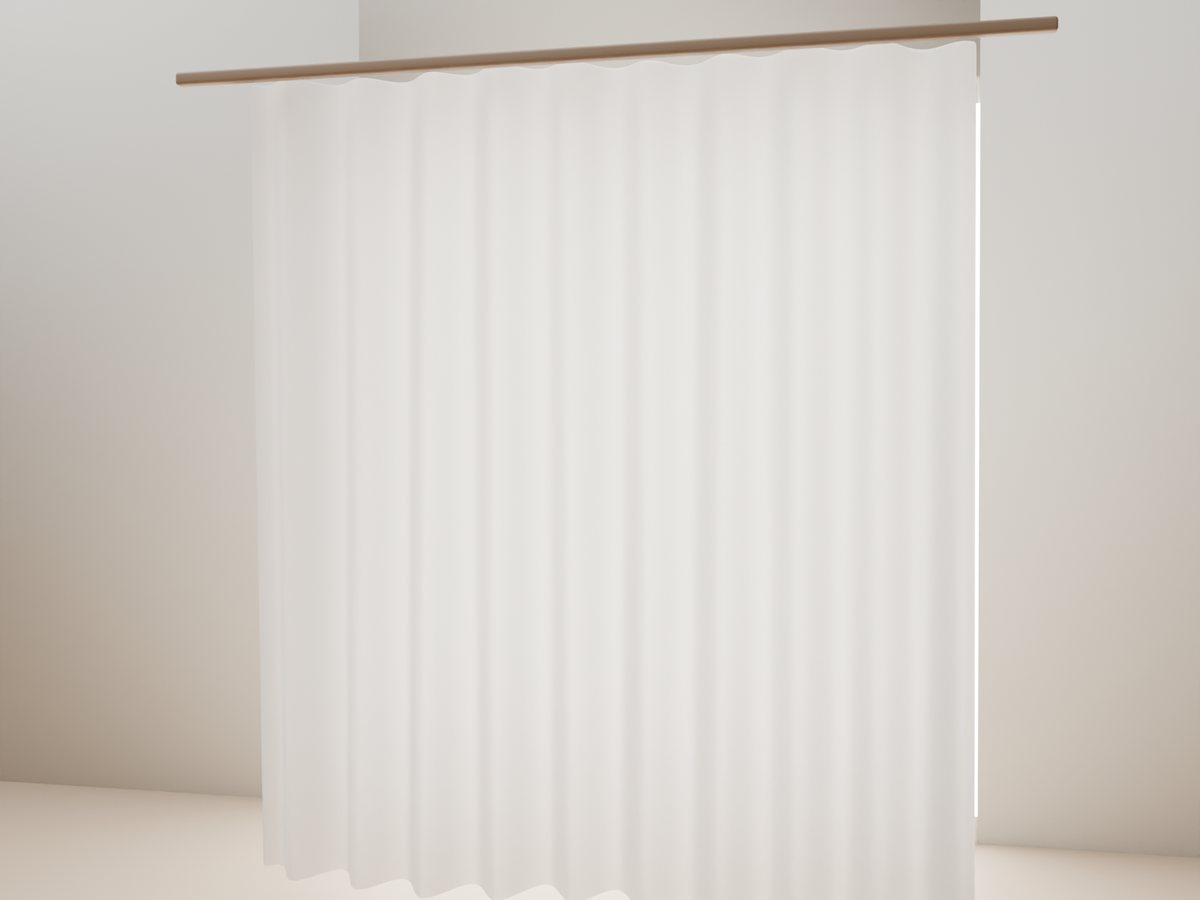
How much is enough
For a Sheer, about two and a half times the width of the rail. A Sheer is light; it needs the extra folds to look like anything at all, and to soften the light evenly across the room.
For a Lined curtain, about twice. The lining gives the cloth body, so a little less of it falls in handsome folds.
The heading changes it a little: eyelets take about twice, pinch pleats a little more, a ripple fold the most.
Measure the rail, not the window
Measure the rail or track from end to end, not the glass. A rail should run past the window by 15 to 20 cm on each side, so the curtains can be drawn clear of the glass and let all the light in.
For the drop, measure from the rail down to where the curtain should end: a centimetre clear of the floor, touching it with a slight break, just above the sill, or a hand's width below it. Measure at both ends and in the middle. Floors and ceilings are rarely level, and for a curtain meant to clear the floor, the shortest measure is the one that counts.
What to look for
Work out the fullness.
Ask how wide the cloth is before it is gathered, and divide it by the width of your rail. Below two for a Lined curtain, or two and a half for a Sheer, it will hang thin.
Hold the cloth up to a window.
Daylight, not the shop's lamps. See how much it lets through, what colour the light turns, and whether the weave shows thin places.
Look at the hems.
The sides should be turned twice. The bottom hem should be deep and doubled, around 10 cm on a Lined curtain, and weighted, so the curtain hangs straight and finds its folds again after a breeze.
Check the pattern at the joins.
Where two widths of a patterned cloth are sewn together, the pattern should run on across the seam. Matching it costs extra cloth, which is why it is so often skipped.
Ask about the sun.
Every dye fades in a window that takes the afternoon sun. A lining protects the face cloth; ask how the colour stands up to light, and how it will look after a summer.
Ask the seller
SKYDROTo take to the shop
Why a curtain needs twice the cloth of its window
Look for
Ask
Tick them off at the counter — ours, or anyone's.
What we do
We cut every curtain to your rail and your drop: two and a half times the width for a Sheer, twice for a Lined curtain(LO), with a weight sewn into every hem and the hem turned twice. Put your rail and drop into Measure a window and it works out the cloth for you.
Ask our team
Something this article did not answer?
Read next
- 04Will the colour last? Two tests at the counter(SAMPLE)Some dyes stay in the cloth. Some leave with the first wash, on your hands, or in the sun. Two tests you can do in the shop, and one at home.
- 02Five things to check on a towel before you pay(SAMPLE)A towel is judged wet, but you buy it dry. Five checks that tell you in the shop how it will behave at home.
Made by the house
Our curtains